


How to Remove a Tree in London, ON: The Steps, the Permit Rules, and How I Think About It
Measure first, confirm who owns the tree, then follow the City permit path if you need one. Here is how I walk London, ON homeowners through it.

In London, ON, a privately owned tree with a trunk diameter of 50 cm or more, measured 1.4 m above the ground, inside the City's Urban Growth Boundary, is a "Distinctive Tree" under the Tree Protection By-law (C.P.-1555-252). You need a City permit, supported by an arborist's report, before you remove it. If your property is inside a Tree Protection Area, trees of any size need a permit. Trees under 50 cm that are not in a Tree Protection Area are exempt from the by-law, so no City permit is needed. Trees on the City boulevard belong to the City, and only the City can work on them.
The short answer
Those are the rules. The rest of this post is the step by step, plus how I think about the bigger question underneath it: should this tree come down at all?
Where Koala Tree stands on removal
I want to be upfront about this, because it shapes every visit I make.
We are not anti-removal. We are anti-unnecessary removal. Some trees need to come down. A tree that is dead, structurally failing over a house, or killing itself on a foundation it was planted too close to is a tree I will help you remove, safely and properly. We do tree removal in London, ON every week, including crane and technical removals.
What I won't do is sell you on fear. You will never hear "that thing could come down any minute" from me unless the evidence actually says so. My job is to give you the facts: what is actually going on with the tree, what your options are, and what the real risks of each option look like. Then you decide where your risk tolerance sits. Some people are comfortable keeping a large tree with a known defect and managing it. Others want it gone. Both can be reasonable decisions, as long as they are made with good information.
That's also why I hold the ISA Tree Risk Assessment Qualification (TRAQ). It gives me a structured, defensible way to rate risk instead of guessing at it.
Step one for everyone: measure your tree
Before anything else, find out which side of the line your tree is on.
- Wrap a soft tape measure around the trunk at 1.4 m (about 4.5 ft) above the ground. If the ground slopes, the by-law measures from the highest side.
- Divide the circumference by 3.14. That gives you the diameter.
- If the result is 50 cm or more, treat it as a Distinctive Tree. As a rough guide, that's a circumference of about 157 cm (just over 5 ft).
Multi-stem trees and trees right near the threshold are worth having an arborist measure. Getting this wrong is expensive (more on fines below).
How do I remove a tree under 50 cm in London, ON?
If your tree is under 50 cm in diameter and your property is not in a Tree Protection Area, the Tree Protection By-law does not apply (section 5.1(m)). You don't need a City permit. There are still a few steps I'd never skip:
- Confirm it's your tree. If it sits on the City boulevard (the strip between the sidewalk and the road, or the road and your property line), it belongs to the City. See the boulevard section below.
- Check for a Tree Protection Area. The maps are included in the by-law itself. If you're inside one, size doesn't matter and you need a permit.
- Check whether it's a boundary tree. If any part of the trunk sits on the property line, it is jointly owned with your neighbour under section 10 of Ontario's Forestry Act, and you need their consent before removing or injuring it.
- Check for nesting birds. The federal Migratory Birds Convention Act protects active nests. Look before you cut, especially in spring and early summer.
- Ask whether removal is the right call. A smaller tree with a problem is often a pruning job, not a removal. Good prescription pruning or, in the right situation, cabling can solve the issue. (And please don't let anyone talk you into topping instead.)
- Hire a fully insured, certified arborist. No permit doesn't mean no risk. Tree work is dangerous at any size (more on that below), and you'll still need utility locates before any stump grinding.
How do I remove a tree 50 cm or more in London, ON?
This is the Distinctive Tree path. Here are the steps in order.
- Get an arborist on site. The by-law requires an Arborist Report for a Distinctive Tree Permit, or an Arborist Opinion if the tree is a Dead Distinctive Tree. The by-law's definition of Arborist includes an ISA Certified Arborist. The arborist confirms species, diameter and condition, and documents the reasons.
- Understand what the City will accept. Under section 8.2, the City Engineer issues a permit only when the application is complete, there are no reasonable alternatives to removal, and at least one accepted ground applies. Those grounds include: the tree is dead; an arborist's opinion that it is unsafe; an engineer's opinion that it is damaging or likely to damage load-bearing or roof structures; removal is needed for a building permit, a swimming pool, or required utilities; or removal represents good arboricultural practice.
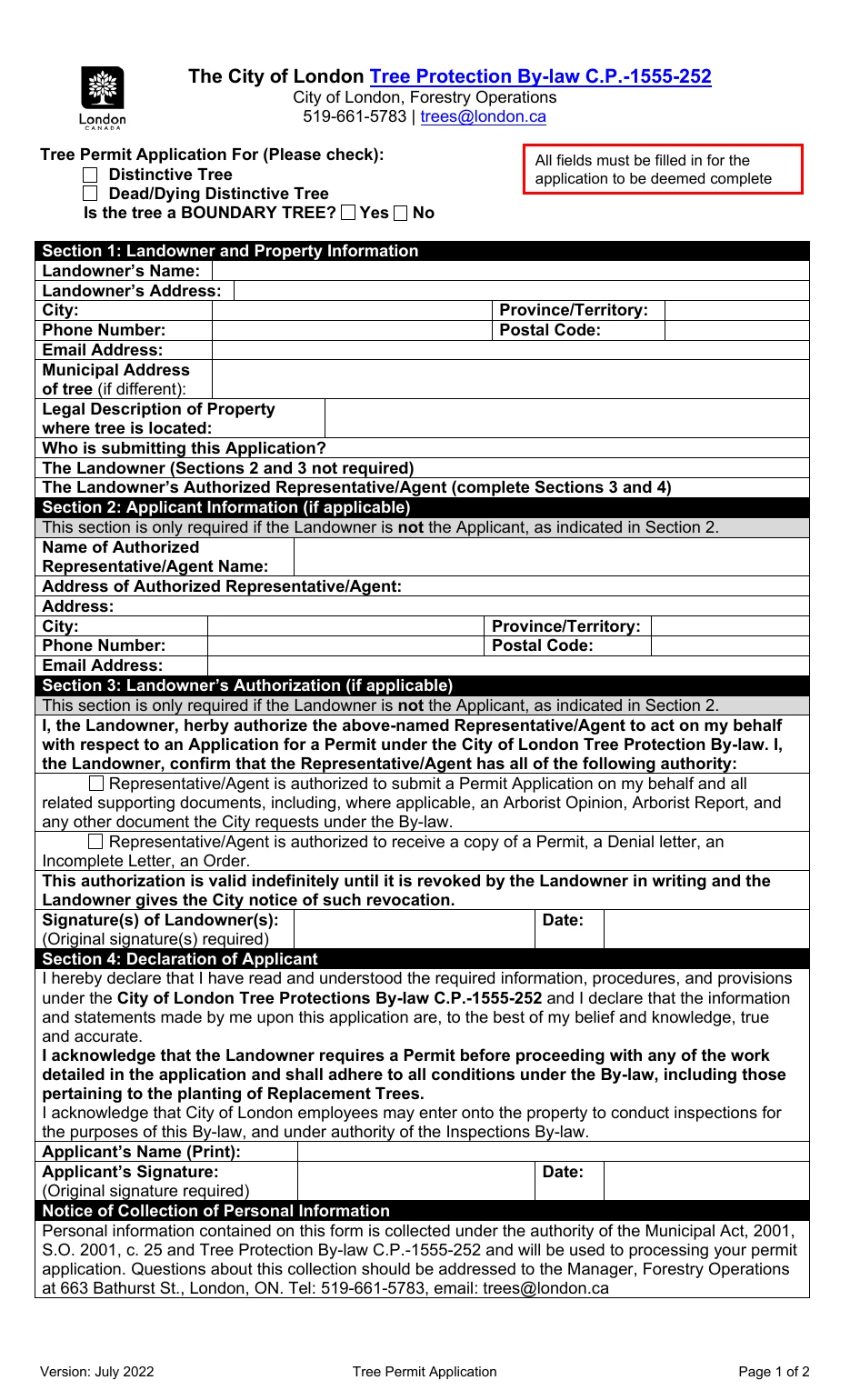
- Fill out the Private Tree Permit Application. Download the Private Tree Permit Application Form (PDF) from the City's Privately owned trees page. Page 1 is yours: landowner and property details, including the legal description of the property, and whether it's a boundary tree. If someone (like your arborist) is applying for you, you sign the authorization in Section 3.
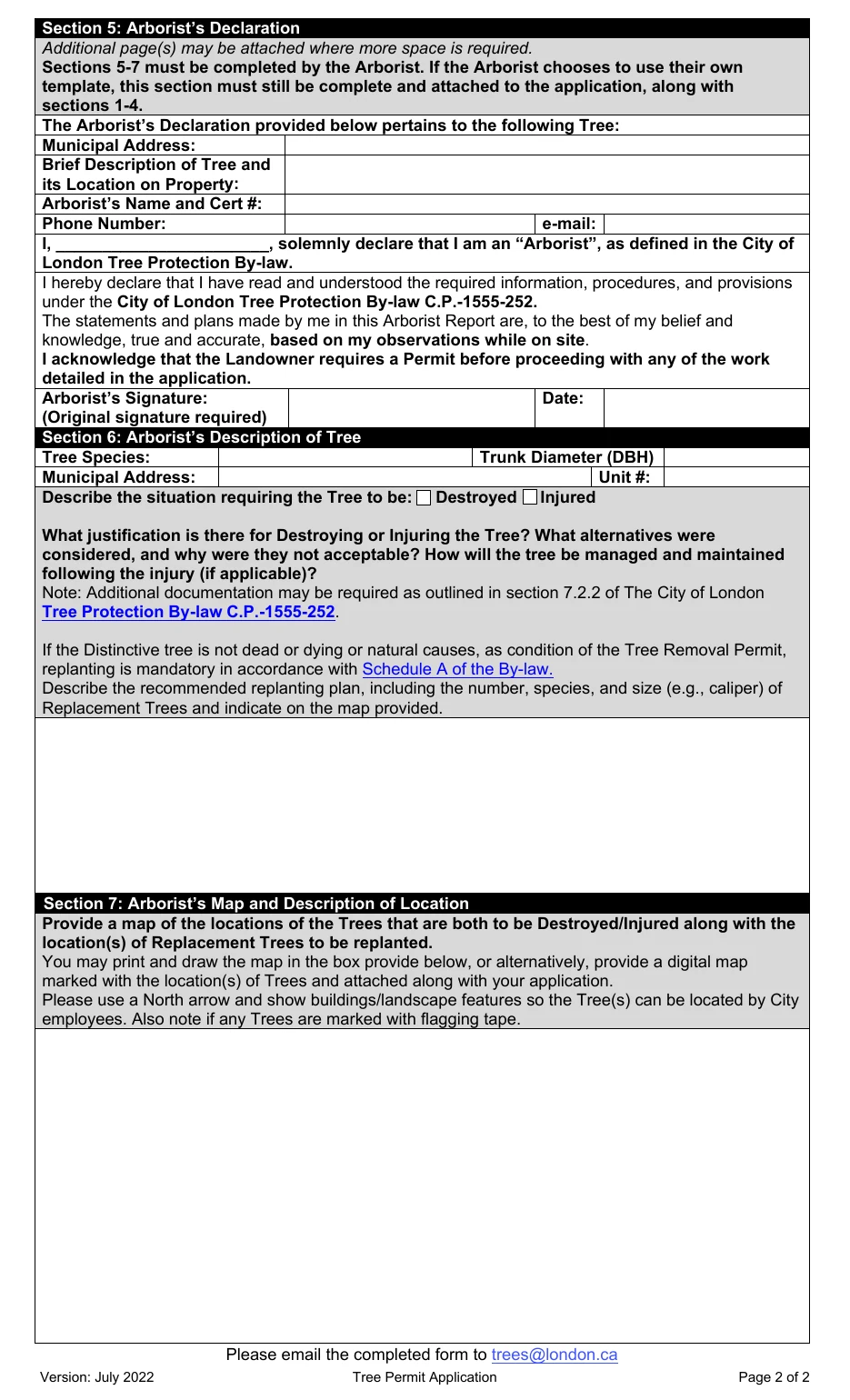
- Your arborist completes Sections 5 to 7. That's the arborist's declaration, a description of the tree, the justification and the alternatives considered, a replanting plan, and a map showing the tree and where the replacement trees will go.
- Boundary tree? Everyone signs. If the trunk crosses the property line, all owners must apply, or the City won't issue the permit (section 7.5).
- Email it in. Completed forms go to trees@london.ca (Forestry Operations, 519-661-5783). Submitting gives City staff permission to come onto your property to inspect.
- Respond to any follow-up within 60 days. If the City asks for more information and doesn't get it within 60 days, the application is treated as incomplete.
- Plan for replacement trees. A live Distinctive Tree permit comes with mandatory replanting under Schedule A of the by-law. The number of replacements scales with the diameter of the tree removed. If your yard can't fit them all, the City charges $350 for each replacement tree that can't be planted on site. Dead Distinctive Trees don't carry the replanting requirement.
- Wait for the permit, then follow its conditions. The permit shows its issue and expiry dates. Work has to follow every condition on it, including compliance with the Migratory Birds Convention Act. If you disagree with a decision, the by-law sets out a 30-day appeal window.
What about a tree in a Tree Protection Area?
If your property falls in a Tree Protection Area, the City asks you to email trees@london.ca with a short description of your project first. Depending on the size of the treed area and the work, they'll require a report from an arborist or a Registered Professional Forester.
What about City boulevard trees?
The City maintains every tree on City property, including boulevards, parks and woodlands, and residents are not permitted to work on them. Those trees are covered by the separate Boulevard Tree Protection By-law. If a City tree worries you, report a forestry issue or request an inspection online or call 519-661-5783. The City's tree maintenance page explains how they prioritize that work by hazard and risk.
Is there an exemption for dangerous or dead trees?
Yes, but narrower than people think. The by-law exempts a tree that is an immediate threat to health or safety, and work done at the direction of emergency services. A tree that is merely dead, or one you're worried about, is not automatically exempt. A dead tree 50 cm or more still needs a Dead Distinctive Tree Permit, supported by an arborist's opinion that it is in advanced, irreversible decline from natural causes.
This is exactly where fear-selling happens. "It's dangerous, we have to take it today" is sometimes true. Usually it isn't. A proper risk assessment separates the two, and if a tree is in slow decline there are often decline management options that buy years.
What happens if you remove a protected tree without a permit?
It's an offence under the by-law. On conviction, fines range from a minimum of $500 to a maximum of $100,000, with a possible special fine of up to $200,000 to remove any economic gain. The City can also issue administrative monetary penalties. It's not worth the shortcut.
Tree work is dangerous: hire a fully insured, certified arborist
Whichever path your tree is on, the removal itself is the riskiest part, and I want to be honest about that. This isn't me trying to scare you. It's a plain fact about the work. A single limb can weigh hundreds or thousands of pounds, wood under tension can move in ways you don't expect, and chainsaws, ladders and nearby power lines leave very little room for error. Even a tree that looks small can seriously hurt someone or damage a roof, a fence or a car.
That's why we recommend a fully insured ISA Certified Arborist for any tree removal, whatever its size. Before anyone starts work on your property, ask for:
- Proof of liability insurance. If something goes wrong, you want their coverage responding, not your home insurance.
- Their ISA certification number, which you can verify on the ISA's website.
- A written quote that spells out the work, the cleanup, and who is handling the permit and the utility locates.
Any reputable company will hand these over without hesitation. If someone can't or won't, that tells you what you need to know.
Before the stump grinder shows up: call for locates
Removing the tree isn't always the end of it. Grinding a stump means digging, and in Ontario you need utility locates before you dig. Request them through Ontario One Call (now the Ontario Dig Authority) a few days before the work. We handle this for our own stump grinding jobs.
Frequently asked questions
Do I need a permit to cut down a tree in London, ON? Only if it's 50 cm or more in diameter at 1.4 m and inside the City's Urban Growth Boundary, or it's in a Tree Protection Area, where trees of any size are covered. Smaller trees outside those areas are exempt. The by-law also exempts a tree that is an immediate threat to health or safety, and work done at the direction of emergency services.
How do I measure a tree for a London tree permit? Measure the trunk circumference at 1.4 m above ground and divide by 3.14. 50 cm or more means it's a Distinctive Tree.
Do I need an arborist report? Yes, for a Distinctive Tree Permit. A dead Distinctive Tree needs an arborist's written opinion instead.
Where do I send the application? Email the completed Private Tree Permit Application to trees@london.ca.
Can I remove a tree on the boulevard in front of my house? No. Boulevard trees are City trees. Request an inspection through the City instead.
Can I remove a tree on the property line? Only with your neighbour's agreement. Boundary trees are common property under the Forestry Act, and London requires all owners to apply for a permit.
Can I remove a small tree myself? If it's under 50 cm and not in a Tree Protection Area, you don't need a City permit. But tree work is dangerous at any size, and we recommend a fully insured, certified arborist for any removal.
Will I have to plant new trees? For a live Distinctive Tree, yes. The number depends on the size of the tree removed, and there's a $350 fee for each one that can't fit on your property.
The bottom line
Removing a tree in London is not complicated once you know which path you're on. Measure first, confirm ownership, check the protected areas, and get a qualified opinion before you decide anything permanent. For a deeper look at the permit side, our London tree removal permit help summarizes the by-law in one place.
If you've got a tree you're unsure about, I'm happy to come look at it. I'll tell you what I see, what your options are, and what the risks honestly look like. If it needs to come down, we'll handle the permit and the removal. If it doesn't, I'll tell you that too. No pressure either way. Book a tree assessment whenever you're ready.
This post summarizes the City of London Tree Protection By-law as of November 2026 and is not legal advice. Always check the current by-law before you act.
Tree removal in London, ON, in four lines
- Measure at 1.4 m: 50 cm or more in diameter means a City permit.
- Check ownership first: boulevard trees are the City’s, boundary trees need your neighbour.
- Any size is dangerous work: hire a fully insured, certified arborist.
- Not sure it needs to go? Book an assessment before you decide.
This is general information. Every tree and site is different. For advice on a specific tree, get a free quote or book a Certified Arborist Assessment.
Jason Korkidakis
Jason is Koala Tree’s Owner and Lead Arborist in London, ON. He leads an 8-person crew and assesses trees for homeowners, condo boards and property managers.
Related notes and help

What a crane removal day looks like
How we plan, rig and lift a tree out when there is no room to drop it.
Learn more
Is My Tree Dangerous? What TRAQ Means
A documented risk rating tells you whether a tree really needs to come down.
Learn moreCertified Arborist Assessment
Jason assesses the tree on site and explains the options. $150.
Learn more
Have a tree you’re worried about?
Get a free quote if you know the work you need, or book an assessment if you’d like Jason to look at the tree first.
Prefer to talk? Call 226-224-5877 · Mon to Fri, 8:00 am to 6:00 pm · info@koalatree.ca